Evolving UX Design at Dun & Bradstreet
2020 - 2024
Overview
In 2020, an executive mandate required the orchestration of design excellence across the entire $2.3B portfolio, including Finance and Risk Solutions (F&RS), Sales & Marketing Solutions (S&MS), Public Sector, International, and Small Business (SMB).
UX Oversight: Directed DesignOps, design system development and governance, and Accessibility governance for the $2.3B+ enterprise.
Portfolio Management: Managed design and product strategy for a $1.3B+ portfolio across Finance & Risk, Public Sector, and Small Business.
Ecosystem Scale: Optimized digital platforms with over 5 million monthly visits, growing at 16% YoY.
Innovation Velocity: Accelerated the delivery of 9+ all-new segment products, securing millions in net-new revenue streams.
People Management: Introduced management systems for interviewing, onboarding, knowledge retention, career ladders, and resource utilization; directly managed seven reports, including their cross-functional team integrations and the processes for engagement.
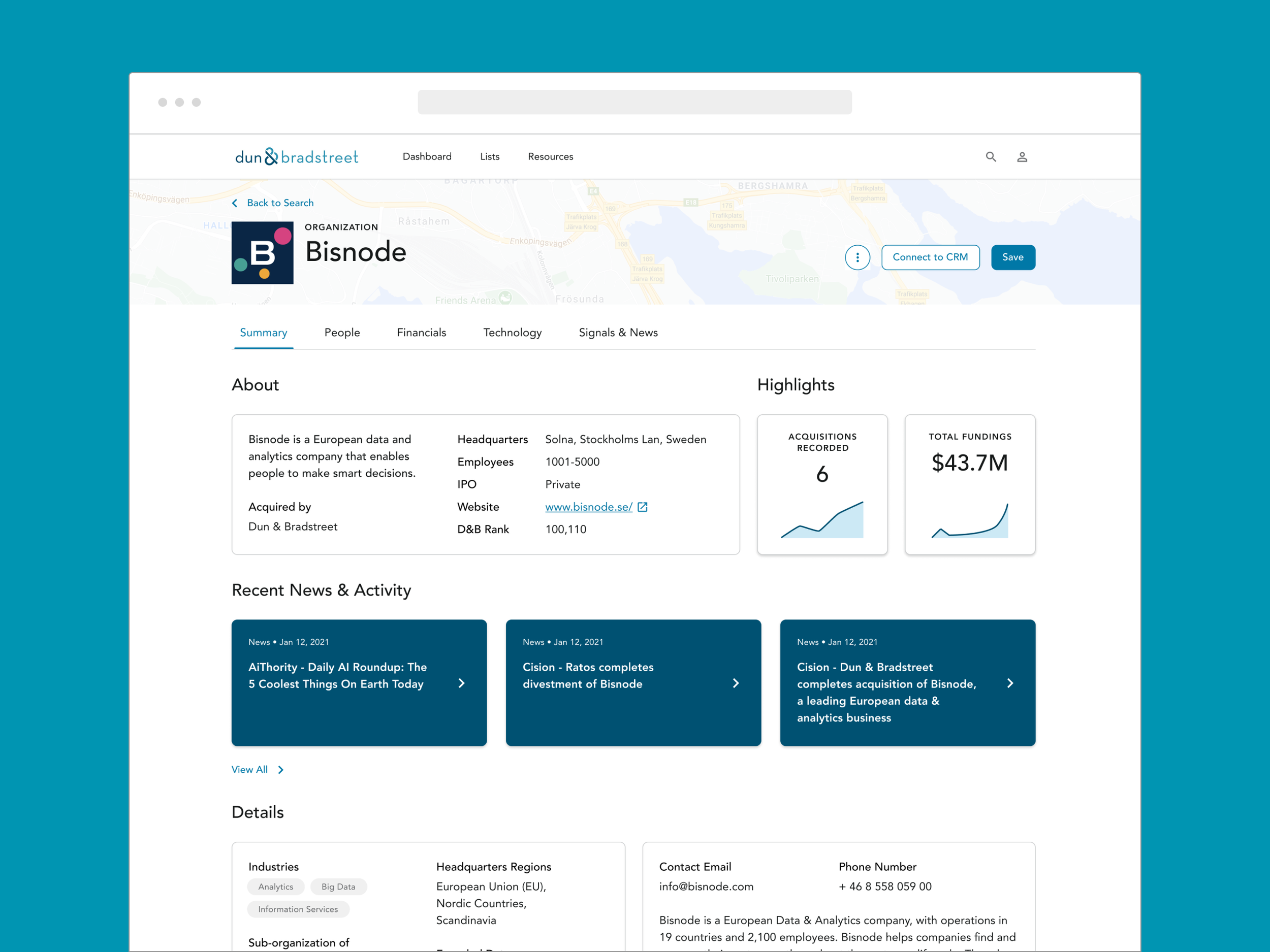
Illustrative concept design utilizing the new D&B Design System
Modernizing the Design Function
Dun & Bradstreet (D&B) faced institutional friction that threatened its market dominance. Fragmented and outdated design systems and management frameworks were scattered across dozens of products and teams, many of which had no defined processes. Decentralized leadership and a lack of validated user insights created operational drag and legal vulnerability.
Strategic Pain Points
Systemic Legal Exposure: Pervasive WCAG non-compliance across the enterprise presented significant litigation and reputational risk.
Operational Inefficiency: The absence of a unified design system resulted in redundant work cycles and brand fragmentation across the global portfolio.
Resource Misallocation: Product decisions lacked "Voice of the Customer" validation, leading to wasted development cycles on unverified features.
Legacy Stagnation: The central SMB digital platform required a modern strategic reimagining to reverse attrition and capitalize on new customer acquisition flows.
Departmental Churn: Lack of a structured organizational design and professional development framework led to above average churn and dissatisfaction.
Challenge Statement
The comprehensive overhaul of the entire design function, including centralization, was an operational necessity to mitigate multi-billion dollar enterprise risk and modernize legacy assets.
Leadership Actions
Institutionalizing DesignOps and Governance
Strategic transformation was achieved by moving design from a fragmented tactical support function to a scalable enterprise asset through the implementation of robust DesignOps and governance.
Design as a Scalable Asset
Architected and delivered the corporation’s first global design system and governance framework.
Built and centralized the UX Research practice, integrating systematic voice-of-customer data into product roadmaps.
Modernized and centralized the software stack, transitioning from Sketch to Figma, eliminating peripheral legacy software, and consolidating to a singular design repository, saving more than 50% in software costs.
Risk Mitigation via Accessibility
Institutionalized the first global A11y/WCAG program as a cornerstone of the enterprise risk management strategy.
Team Development and Integration
Created the first centralized design leadership and management program, including systems for hiring, onboarding, resourcing, and performance development.
Product Innovation and Platform Optimization
Capitalized on new systems and tools by leading the design and launch of over nine new products in high-growth sectors, as well as optimizing the most used products and flows in the Small Business segment. Product launches and optimization led to millions in new revenue and industry accolades.
Spearheaded the design of mission-critical solutions in:
Artificial Intelligence: Spearheaded the design of the company’s first GenAI-driven products across the enterprise.
Risk & Compliance: Launched all new products from 0→1 for KYC (Know Your Customer), KYB (Know your Buyer), Fraud prevention, Cyber Risk mitigation, and ESG (Environmental, Social, and Governance).
Financial Services: Oversaw the design and launch of the company’s new small business credit platform, D&B Credit Insights, reimagining the solution and securing top industry ratings.
Public Sector: Received industry praise from Gartner and Databricks for products and solutions enabling large government departments to operationalize “AI-ready” data.
Small Business: Optimized the largest acquisition flow in the company for securing a D-U-N-S number, and reimagined the centralized small business platform, My D&B, increasing user satisfaction and winning a Gold Stevie for the mobile app.
Performance Snapshot
| Initiative | KPI | Outcome |
|---|---|---|
| New Product Launches | Revenue Growth | Generated millions in new revenue |
| Product Design & Development | Enterprise Retention Rate | Maintained ~96% client revenue retention rate |
| D-U-N-S Number Acquisition Flow | Conversion Rate | ~70% increase in digital conversions |
| A11y/WCAG Program | Legal Risk Mitigation | Enterprise-wide roadmap for 100% WCAG 2.1 AA compliance |
| People Program | Employee Retention | 100% direct report retention post-implementation |
Conclusion
The High-Performance Design Culture
Transforming design leadership at D&B became a primary driver of enterprise value. By institutionalizing DesignOps and prioritizing validated innovation, the portfolio transitioned from a fragmented legacy state into a modern, accessible, and scalable market leader.
Takeaways
Design Governance as a Hedge Against Legal Liability: In a multi-billion dollar enterprise, global accessibility and unified design systems are critical risk-mitigation tools that protect the brand while ensuring scalability.
Optimizing Legacy Assets for Exponential Returns: Significant performance gains—such as the 70% increase in SMB conversions—are achievable in legacy environments when user-centric flows are aligned with strategic business outcomes.
Research-Backed Roadmaps Eliminate Development Waste: Centralizing research data transforms the product lifecycle from a reactive process into a proactive, ROI-driven strategy that ensures every development dollar is spent on validated market needs.