Transforming the Executive Relocation Experience
2018
Overview
I was engaged through my consulting company to design an industry-first product in collaboration with Capital One empowering users to control and customize their relocation experience.
User Research: Created and executed foundational user research with Capital One’s relocating employees.
Product Definition: Synthesized market and user data to define product requirements and opportunities for innovation.
UX Design: Designed and tested the entire experience across desktop and mobile.
Account Management: Managed key relationships and communications with Capital One and Plus Relocation.
Service Design: Defined and designed the end-to-end relocation experience, from the talking points of a hiring manager to the reception of benefits.
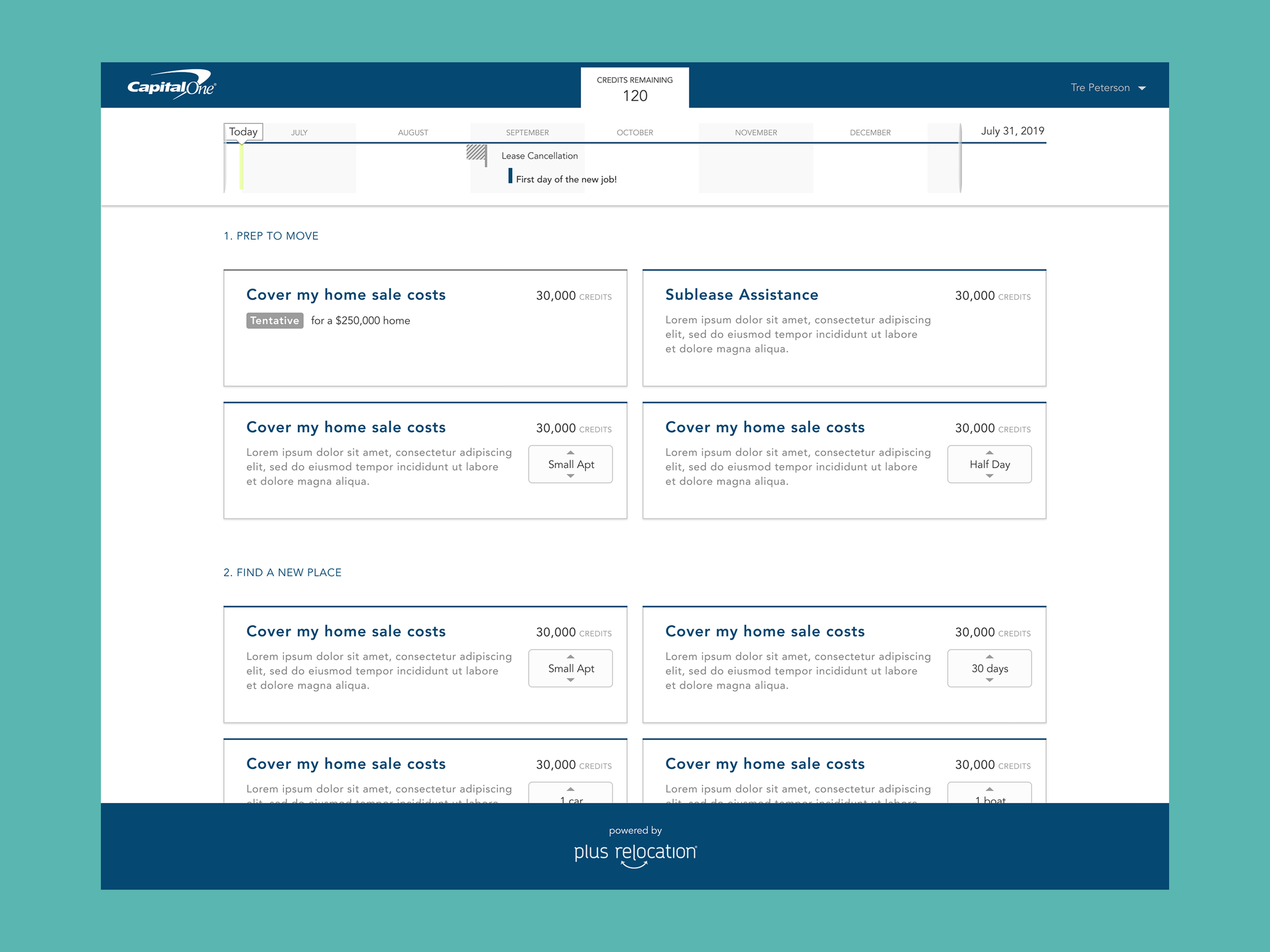
Early Point C design displaying active timeline and tentative benefit selection
0 → 1 Creation of a Revolutionary Experience
In 2018, the relocation experience was often one-size-fits-all, rigid, and opaque for the end-employee. It relied heavily on manual communication, leading to "policy exception" bottlenecks that frustrated both HR and employees.
Strategic Pain Points
One-size-fits-all benefits: Employees often received pre-packaged benefits which had little or no relevance to their personal scenario.
Rigid policies: Pre-packaged benefits were often difficult or impossible to change, unless granted the rare “policy exception,” which introduced complications for managers.
Opaque delivery: Employees were unclear when and how they would receive their benefits from “black box” third-party providers.
Manual management: For decades, the relocation industry was defined by manual, high-touch coordination, requiring manual requests to trickle through a chain of third parties.
Variable channels: Employees often received their relocation direction and guidance from a complex web of people and channels.
Challenge Statement
Plus Relocation must evolve from a rigid, labor-intensive provider into a flexible automated platform to decouple revenue growth from manual operations, reduce costs, and defend market share against emerging 'Relo-Tech' startups.
Consultant Actions
Discovery Research and Product Definition
To elucidate the user segmentation, pain points, and opportunities, I defined and executed a research plan creating the data-informed basis for the near-term product roadmap.
Persona Segmentation: Conducted background research to determine newly quantified user personas, segmenting by benefit value and scope of required services.
User Research: Facilitated recruitment of new personas, and conducted user interviews to understand challenges and opportunities in the pre, during, and post-relocation experience.
Product Definition: Defined essential features, benefits, and product scope based on synthesis of discovery data.
Product Design and Innovation
My research revealed several innovative opportunities that would help differentiate Point C beyond basic customization and digitization. I led the definition, prioritization, and design of these new, innovative features.
Relocation Onboarding: A simple, user-friendly email-to-onboarding experience was designed to establish Point C as the user’s unified relocation command center.
Relocation Timeline: The central theme in user feedback was the lack of transparency and control around when and how benefits could be used. This valuable insight led to the creation of the Timeline, a simple interface visualizing the order of and status of events.
Benefit Scheduling: To facilitate the creation of a functional timeline, the benefits selection process needed to be imbued with scheduling functionality. This included designing a system for scheduling each benefit, as well as communicating its current status.
Granular Customization: To facilitate true perceived customization for the employee, a credit system was developed that allowed the “right-sizing” of each benefit to match the scale of the user’s needs.
Mobile, Desktop, and Service Design: The entire Point C platform was designed from scratch, including all screens across mobile, desktop, and communications touch points.
Performance Snapshot
| Initiative | KPI | Outcome |
|---|---|---|
| Benefit Customization & Transparency | Net Satisfaction (NS) by Trippel Survey & Research | Consistently ranked #1 in the Small-Share Category |
| Product Innovation | Corporate Revenue Growth | ~100% growth (by 2022), led by Point C SaaS fees |
| Process Automation | Cost per Relocation | ~30-40% reduction for relocation administrators |
| Experience Consolidation | Platform Adoption | ~85% Adoption (vs. 30% industry benchmark) |
Conclusion
From Service Provider to Platform Pioneer
The transformation of Plus Relocation via Point C represents a definitive shift in the global mobility landscape—moving from a legacy model of "manual gatekeeper" to a modern era of "user-orchestrated mobility." By applying a design-led approach to a historically rigid industry, I did more than just digitize a process; I restructured the underlying business logic of relocation.
Executive Takeaways
Decoupled Growth from Headcount: Successfully transitioned the business from a labor-intensive service model to a scalable SaaS-enabled platform, reducing administrative overhead by 30–40%.
Pioneered "Managed Flexibility": Engineered a first-of-its-kind granular customization system, leading to ~100% revenue growth over four years, without a linear increase in operational costs.
Solved the "Black Box" Transparency Gap: Designed a unified relocation timeline that aggregated fragmented third-party data into a single source of truth, driving platform adoption to 85%—nearly triple the industry benchmark.
Validated Design-Led Business Value: Leveraged foundational research with Capital One to ensure the MVP addressed high-value pain points, resulting in Plus Relocation achieving the #1 Net Satisfaction (NS) ranking in the Small-Share category.
Service Design Integration: Beyond the digital interface, I orchestrated the end-to-end service design—from hiring manager talking points to vendor communications—ensuring a cohesive brand experience across all physical and digital touchpoints.